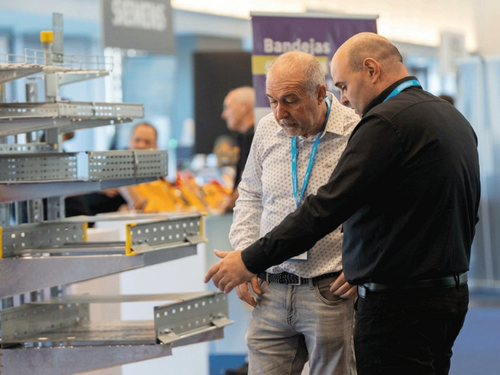
EFINTEC 2026 with PohlCon and cable management solutions for professional installations
At PohlCon Ibérica, we will be exhibiting at EFINTEC 2026, the professional trade fair for the installation and energy sector, on 7 and 8 October in Hall 1 at Fira Barcelona Gran Via.
You will find us at Stand E19, where we will present solutions for organizing, protecting and routing cables in professional installations. This will be an opportunity to review the real conditions affecting your project, answer technical questions and assess which cable management systems best suit the environment, expected load, maintenance requirements and potential future extensions.
Our aim will not be to show you a catalogue in isolation. We want to help you make decisions to simplify installation, reduce issues on site and keep the system accessible and safe throughout its service life.
What you will find at EFINTEC 2026
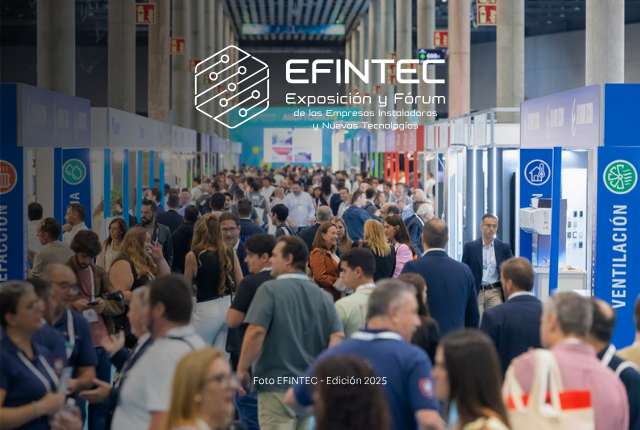
EFINTEC brings together manufacturers, distributors, installers, engineering firms and other professionals working in energy, electrification and technical installations. According to the organisers, the 2026 edition is expected to welcome more than 8,000 professionals and around 180 exhibitors.
The trade fair is structured around four key areas related to the sector's development.
- Energy transition and decarbonisation
- Digitalisation and applied technologies
- Sustainable building
- Talent, professionalisation and collaboration across the value chain
You can find the latest information on dates, opening hours and the programme on the official EFINTEC website.
These themes have a direct impact on how installations are designed. New equipment, the electrification of energy use, renewable generation, energy storage, automation and connectivity all increase the volume and variety of cabling.
This growth requires greater attention to cable routes, accessibility and adaptability. A well-designed installation does not depend only on the cable or the final equipment. It also depends on the infrastructure that organises, supports, protects and keeps all those circuits maintainable.
Visit us at stand E19
At stand E19 at EFINTEC 2026, you will be able to explore different solutions from our catalogue and speak directly with our technical team.
If you work for an engineering firm, installation company, maintenance company or industrial asset owner, you can discuss your project's requirements with us. Together, we will review factors such as loads, support spacing, the installation environment, future growth and the need to keep certain services separate.
In our experience, many issues that arise during installation could be avoided by reviewing the cable support system in advance. A design with too little capacity, unsuitable support spacing or a lack of compatible accessories can complicate installation and generate costs that are not always identified during the tendering stage.
For this reason, we recommend approaching the solution as a complete system. The tray, duct or ladder should work together with its supports, joints, branches, covers and fixing elements.
Cable management solutions for every route
There is no single solution that works for every installation. The right system depends on the real conditions of your project and the function of each route.
Our catalogue includes alternatives for horizontal and vertical routes, exposed installations, technical spaces, industrial areas, floors and locations that require additional protection.
Cable trays, ducts and ladders for organized cable routing
Cable trays, ducts and cable ladders make it possible to create organized, accessible routes. The choice should take account of the cable type, total load, available dimensions and environmental conditions.
It is also important to consider how the installation will evolve. When a system is sized only for its initial occupancy, any extension may require routes to be modified, parallel structures to be added or work to be carried out in areas that have already been completed.
A reasonable capacity reserve makes it easier to add new circuits. The aim is not to oversize without justification, but to balance available space, load, cost and expected growth.
If you are comparing options, our guide on how to choose a cable tray manufacturer covers several criteria that can help you assess system quality, the range of accessories and the supplier's technical support capabilities.
Supports and accessories that complete the system
The performance of a route does not depend on the tray alone. Supports, profiles, joints, branches and fixings all influence stability and ease of installation.
In complex projects, our early-stage advice can help you resolve junctions, changes in level and connections between areas with different requirements. It can also reduce improvised adaptations on site and maintain greater consistency between the different sections.
A system made up of compatible components simplifies the installer's work. The parts are designed to work together and help ensure that future extensions or modifications follow the same technical approach.
At Stand E19, we can review the complete configuration with you, not only the main component. If you have drawings, measurements or photographs of the space, bring them to the meeting. They will help us provide more useful guidance.
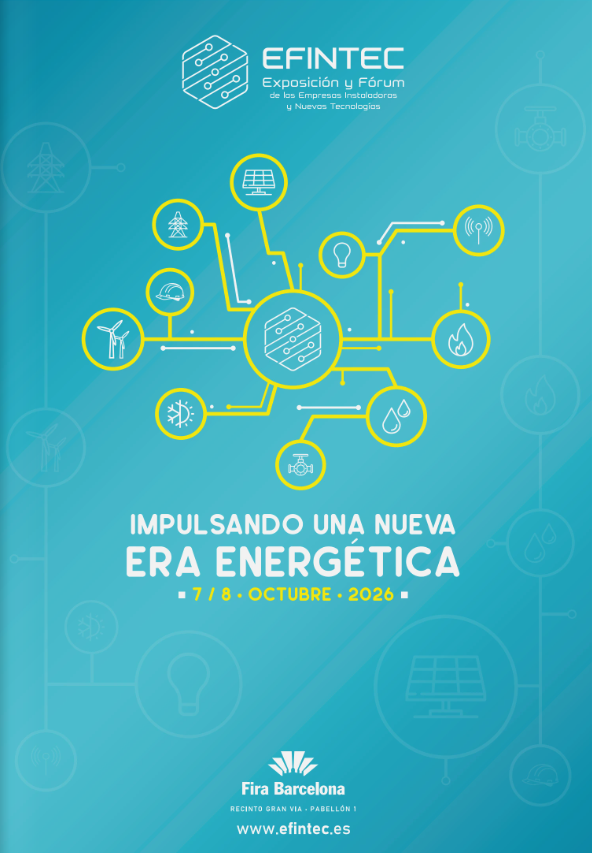
Get free access to EFINTEC 2026
Request your invitation code and book a meeting with our technical team at stand E19. Tell us what you need to resolve in your project and we will prepare the meeting so we can help you from the outset.
Systems for vertical routes
Vertical routes are found in multi-storey buildings, technical rooms, industrial installations and vertical service shafts. At these points, the weight of the cabling and the need to secure it correctly become particularly important.
Vertical ladders and their accessories make it possible to organise cables, maintain suitable separation and facilitate inspection. The design should consider the height, number of cables, accumulated load and available fixing points.
When we review a vertical route, we also consider its connection to the horizontal sections. Resolving this transition correctly helps avoid unnecessary stress on the cables and creates a cleaner, more accessible route.
Underfloor solutions for flexible spaces
Underfloor installations are particularly useful in offices, administrative buildings and other spaces that need to adapt to layout changes.
An underfloor system can bring power and communications to workstations without relying exclusively on walls. This flexibility is valuable when the position of desks, equipment and meeting areas may change over time.
The design must coordinate ducts, boxes, access units and floor finishes. It should also facilitate later work without causing unnecessary damage to the finishes.
When these elements are planned from the outset, the space can respond more effectively to new uses and reduce the complexity of future reorganisations.
Ducts for industrial environments and walkable areas
Certain environments require greater mechanical protection. In industrial plants, workshops and production areas, cables may need to be routed through zones exposed to people, tools or equipment.
Walkable systems must protect the cabling and provide a stable surface. They also require accessories that resolve changes of direction, branches and junctions without creating weak points.
In our article on industrial walkable floor ducts and walkable cable trays, we explain the differences between these solutions and the criteria to consider before selecting one.
What to assess before selecting a cable management system
Before specifying or installing a system, you should review several questions. These decisions affect sizing, material, support type and accessory configuration.
What cables the installation must accommodate
Not all cables have the same diameter, weight or function. The system must make it possible to organise them and maintain the separation required by the project.
It is also important to identify whether power, communications, control or other services will share the same route. This information helps define compartmentation and the internal layout.
How much the installation may need to grow
A realistic growth allowance prevents the route from becoming saturated shortly after commissioning. If you know which extensions are planned, we can help you include them in the sizing process.
In industrial projects or buildings with intensive technology requirements, this question can be particularly relevant. The initial installation rarely remains unchanged throughout the building's entire life.
What loads it must support
Cable weight, support spacing and route configuration affect the system's mechanical performance.
Choosing a tray based only on its external dimensions is not enough. You must check its load capacity within the actual configuration of your project.
EN 61537 for cable tray systems provides a reference framework for assessing the performance of cable tray and cable ladder systems.
Where it will be installed
A dry indoor installation does not have the same requirements as an outdoor, humid or industrial environment, or one exposed to corrosive agents.
The material and surface treatment must be selected for the environment. Inadequate protection can shorten the system's service life and increase maintenance requirements.
In our experience, this criterion should be assessed from the earliest stages. Correcting it once the system has been installed is usually far more complex.
How it will be installed
Available space, accessibility, the construction programme and coordination with other trades all influence installation.
A modular, well-planned system makes installation easier. It also reduces cutting, adaptations and improvised parts.
If you share the installation conditions with us, we can help you identify potential problem areas before they reach the site.
How maintenance and extensions will be carried out
The installation must remain accessible after commissioning. An organised route makes it easier to inspect and identify circuits and to replace or add cables.
For this reason, it is not advisable to fill all available space completely or place routes in inaccessible locations. Ease of maintenance is also part of a well-designed installation.
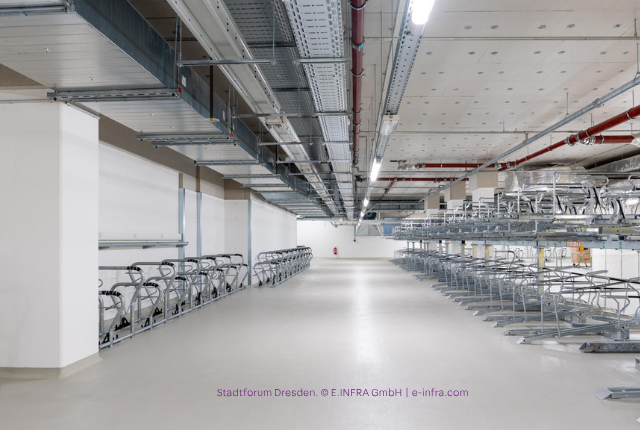
Stadtforum Dresden as an example of integrated cable infrastructure planning
Stadtforum Dresden is a nine-storey administrative building constructed between 2022 and 2025. It has around 1,000 flexible workstations and is designed to accommodate more than 1,350 employees.
We use this project as a reference because it shows how different systems from our catalogue can be coordinated within the same building. The solution had to cover horizontal and vertical routes, underfloor areas and spaces that could be reorganised over time.
Across the PohlCon Group, we supplied a broad package of cable routing and distribution solutions.
- 4.2 kilometres of RG cable trays
- 1,800 MA 60 central suspensions
- 6.5 kilometres of threaded rods
- 700 metres of STU 50 vertical ladders
- 1.3 kilometres of KHA 7 and KHA 8 profiles
- More than 6,000 cable clamps
- Around 450 metres of UKR underfloor system
- 1,600 pre-assembled mounting boxes
- Approximately 1,000 foldable UEK3 installation units, together with device carriers and installation plates
The figures show the scale of the project, but the main lesson lies in coordination. The systems had to work as part of a shared infrastructure and adapt to different areas of the building.
Connected horizontal and vertical routes
RG cable trays organised a large proportion of the horizontal routes. STU 50 ladders handled the vertical distribution and connected the different floors.
Supports, profiles and threaded rods completed the structure needed to keep the routes stable. Cable clamps secured the cables at the planned points.
In your project, this coordination can avoid discontinuities between areas and reduce improvised solutions. It also helps installers work according to a common logic throughout the installation.
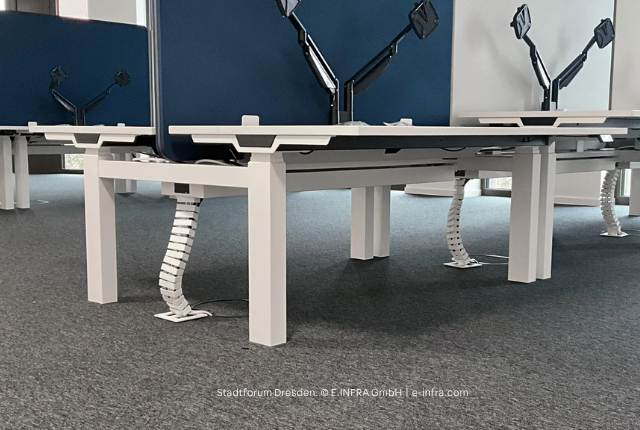
Underfloor flexibility
The UKR system and UEK3 installation units distributed services to the workstations while retaining the option to modify the interior layout.
This flexibility meets the needs of a contemporary administrative building. Spaces can change use, accommodate new equipment or reorganize workstations without the entire installation having to be rebuilt.
If you are designing offices, meeting rooms or shared workspaces, you should consider from the outset where power and communications will need to be available.
A system designed for maintainability
A large number of components should not result in an installation that is difficult to manage. Good planning makes it possible to identify routes, access cables and retain spare capacity for future extensions.
Stadtforum Dresden demonstrates the value of combining compatible systems and planning the connections between them. We apply the same logic when helping you assess an installation, whether it is a large building or a more limited project.
Cable management systems and sustainable buildings
The sustainability of an installation does not depend only on the source of its energy. It is also linked to efficient material use, durability, maintenance and adaptability.
A correctly sized system can reduce later modifications and prevent premature replacement. An accessible installation makes maintenance easier and helps you make better use of the existing infrastructure when new equipment is added.
Modularity also helps. When components can be extended or reorganised, it is easier to adapt the installation without dismantling entire sections.
Our technical team can help you balance these variables. The aim is not to use more material, but to select the system and configuration that respond to the real conditions of your project.
This approach is particularly relevant in buildings that need to adapt to electrification, digitalisation and changes of use. The cable infrastructure must be able to support that evolution.
How to prepare for your visit to the PohlCon stand
EFINTEC brings many companies and activities together over two days. Preparing your visit will help you use your time more effectively and have more focused conversations.
Before coming to stand E19, we recommend gathering the basic information about your project.
- Define its current phase, whether feasibility, design, tendering, construction or expansion.
- Identify the type of building or industrial environment.
- Note the main constraints relating to space, load and environment.
- Gather drawings, diagrams, measurements or photographs that help explain the route.
- Indicate any extensions or changes of use you anticipate.
- Highlight the points that are creating technical questions or installation difficulties.
With this information, we can review the most suitable alternatives with you and prepare a conversation focused on real requirements.
Request your free code and book a technical meeting
At PohlCon Ibérica, we are offering you the opportunity to attend EFINTEC 2026 free of charge. To obtain your ticket, simply request an invitation code through our website.
Request your free code and book a meeting with our technical team. Tell us what you need to resolve in your project and we will prepare the conversation so you can make better use of your time at stand E19.
We will help you review routes, loads, supports, materials, accessories and growth forecasts. If you bring project documentation, we can provide initial guidance during the trade fair and agree the next steps.
Frequently asked questions about EFINTEC 2026
When is EFINTEC 2026?
EFINTEC 2026 will take place on 7 and 8 October 2026.
Before travelling, we recommend checking the final opening hours and any updates on the official event website.
Where will the trade fair take place?
The event will take place in Hall 1 at Fira Barcelona Gran Via.
The venue has public transport connections and access for professional visitors. You should check the organiser's travel information and designated entrances in advance.
Where will the PohlCon stand be?
You will find us at stand E19.
We recommend booking a technical meeting if you want to review a specific project. This will allow us to give you the time you need and prepare the conversation in advance.
You can also consult the official EFINTEC 2026 exhibitor list.
Who is EFINTEC for?
The trade fair is intended for professionals working in installation, energy, engineering, distribution, maintenance and construction.
If you are involved in defining, purchasing, installing or maintaining electrical and communications systems, you will find suppliers, solutions and content related to your work.
What will we present at EFINTEC 2026?
At our stand, you will be able to explore solutions for routing, supporting and protecting cables.
We will cover systems for horizontal and vertical routes, underfloor installations, industrial environments and projects that need to plan for future extensions.
You will also be able to speak with our team about selection criteria and the most suitable configuration for your installation.
How can I get a free ticket?
You can request your invitation code through the PohlCon Ibérica website. Complete the form, book a meeting with our technical team and briefly tell us what type of solution you need. We will email you the code and prepare the meeting at stand E19.
What information should I bring to the meeting?
Drawings, diagrams, measurements and photographs will help us understand the project. Information about loads, dimensions, the installation environment and growth forecasts is also useful.
You do not need to have all the documentation finalized. We can advise you from the earliest stages and help you identify the information needed to move forward.
Let's discuss your project at EFINTEC 2026
EFINTEC 2026 will be an opportunity to discover new solutions, exchange experience and prepare installations for the changes they will need to address in the coming years.
At PohlCon Ibérica, we want to use the trade fair to listen to you and help resolve specific requirements. Our experience in cable management systems allows us to assess the complete route, from selecting the tray or duct to defining supports, accessories and access points.
Request your free entry code, book a meeting and visit us at Stand E19. We will review your project's conditions with you and help define a safe, organized solution that is ready to grow.