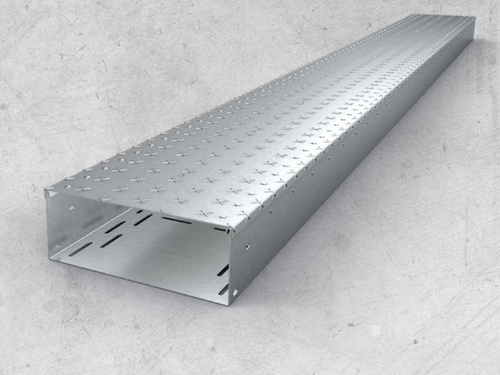
Industrial walkable floor ducts: when to choose a walkable cable tray
In many industrial facilities, cable routing cannot always be solved from the ceiling, the wall or elevated structures. There are production lines, machinery, robotic cells and technical walkways where the distribution of power, data, compressed air or auxiliary lines must run at floor level.
In these cases, common questions arise: is a cable floor cover enough, is a cable protector sufficient, should a floor duct be installed, and when are we really talking about a walkable cable tray?
Based on our experience in industrial projects, the difference is not merely that the system can be walked on. The decisive point is whether the solution forms part of a permanent, safe and inspectable technical infrastructure prepared to operate in demanding environments.
In this article, we explain what industrial walkable floor ducts are, how they differ from conventional cable floor covers and what criteria should be reviewed before choosing a solution for floor-level cable routing.
What are industrial walkable floor ducts?
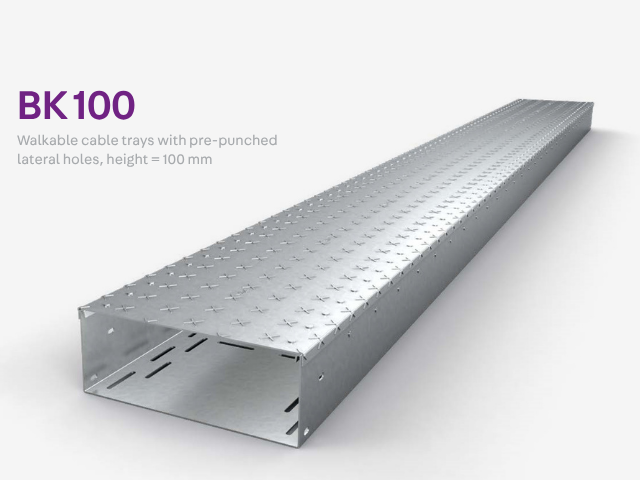
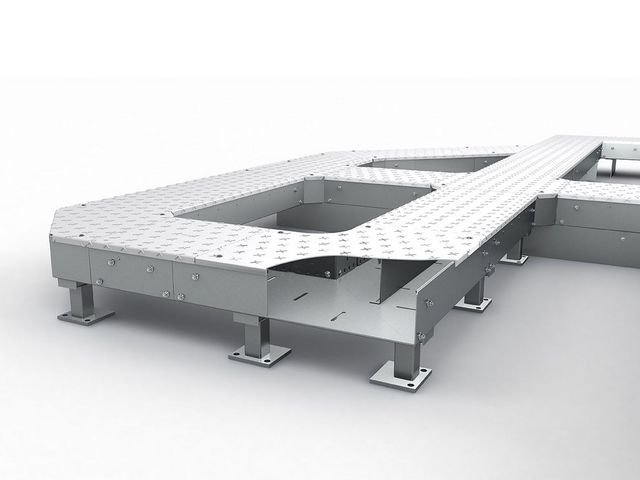
Industrial walkable floor ducts are systems designed to route and protect cables or supply lines at floor level in production environments. Their main function is to provide orderly, accessible and protected routes when the cable run must cross work areas, machinery areas or spaces with technical foot traffic.
At PohlCon, we work with these solutions within our range of industrial cable tray systems. The approach consists of designing a technical system composed of the duct, cover, formed parts, accessories, joining elements, supports and equipotential bonding components, far beyond a simple surface-mounted cable cover.
In practice, an industrial walkable floor duct can be used to route:
- electrical cables
- data cables
- pneumatic lines
- hydraulic lines
- auxiliary supply lines
- cabling associated with machinery or automation
What we have seen in industrial projects is that these solutions often appear when the route must coexist with machinery, workstations, robots, assembly lines or areas where the cabling needs protection against impacts, dirt, sparks, operator traffic or external interference.
A walkable floor duct that is well selected helps organise the installation, protects the supply lines and facilitates future maintenance work. This combination of protection, accessibility and safety is what sets it apart from lighter solutions.
Difference between a cable floor cover, a cable floor protector and an industrial walkable floor duct
A significant part of the confusion comes from the use of similar terms. On Google, when searching for walkable ducts, very different products appear. Some results show cable floor covers for offices, events or commercial areas. Others show floor cable protectors, usually designed to protect specific cable routes or temporary runs. And others do correspond to walkable industrial systems.
The practical difference can be summarized in three groups.
Cable floor cover
A cable floor cover is usually used to organise and protect cables along visible routes, often in indoor environments, offices, shops or spaces with lower mechanical requirements. Its purpose is usually related to avoiding trip hazards, keeping cables orderly and offering a simple installation solution.
It may be useful for light-duty routes, but it is not always designed for industrial plants, automated lines or permanent technical supply routes.
Floor cable protector
A floor cable protector is usually used to protect cables that cross passage areas at specific points. It is common in events, warehouses, temporary spaces or areas where exposed cables need to be avoided.
In many cases, this type of product is installed on top of the floor and works as surface protection. It can solve a specific need, but it does not replace industrial cable routing infrastructure when there are requirements for maintenance, technical integration, electrical continuity, electromagnetic compatibility or complex routes.
Industrial walkable floor duct
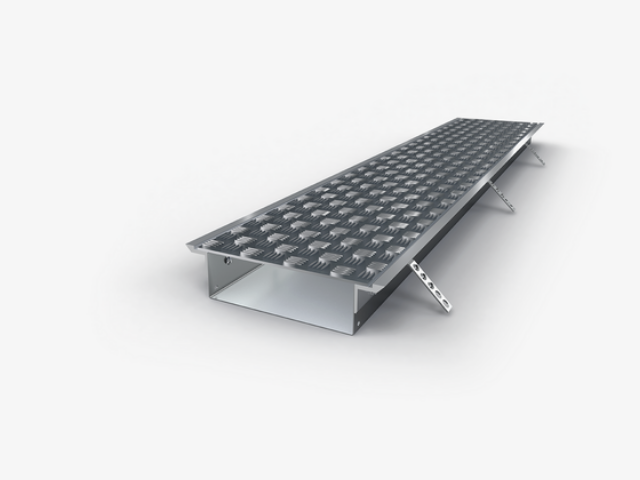
An industrial walkable floor duct is designed as a cable management system within a technical installation. It can be integrated into permanent routes, accept specific covers and include branch pieces, crossovers, bends, separators, supports and accessories to adapt the route to the reality of the plant.
When we talk about a walkable cable tray, the objective is to design a safe, inspectable and resistant routing solution prepared to operate within an industrial environment.
When should industrial walkable floor ducts be used?
In our experience, industrial walkable floor ducts are especially useful when cabling has to run close to the floor and it is not advisable to solve it with elevated cable trays, conduits, light-duty cable covers or improvised solutions.
This criterion connects directly with an idea we already developed in our article on industrial electrical cable routing, where we explain why well-planned cabling infrastructure helps avoid stoppages, incidents and cost overruns in the plant.
Automated production lines
In automated lines, cabling must reach machines, control stations, robots, sensors, auxiliary panels and supply systems. It is not always possible to solve every route from the ceiling or the wall. Sometimes, the route has to cross production areas or run at floor level to connect specific equipment.
In these cases, the walkable duct protects the lines, keeps the installation orderly and preserves accessibility for future modifications.
Automotive industry
The automotive sector is one of the environments where this type of solution makes the most sense. Production plants usually work with long routes, automated machinery, robots, pneumatic systems, electrical lines and industrial data.
In these projects, cabling cannot be left exposed to or depend on insufficiently robust solutions. A well-designed walkable system makes it possible to route supply lines through work areas where safety, order and operational continuity are critical.
Machine building and industrial plants
In machine building, production facilities and industrial plants, cable routes often change according to the plant layout. The solution must adapt to straight runs, changes of direction, branches, crossovers and connections with other systems.
Here, the route should be planned as a complete system, especially when the duct must coexist with other supply lines or with machinery that may be modified over time.
Maintenance areas and technical walkways
In areas where operators need access to machinery, auxiliary equipment or service areas, cabling must be protected without creating additional risks. Walkable covers, slip resistance and correct integration of the system into the floor are determining factors.
An incorrect choice can create trip hazards, dirt accumulation, difficult access or occupational safety problems.
Technical criteria to review before choosing an industrial walkable floor duct
Choosing an industrial walkable floor duct should not be based only on width or price per metre. In real projects, several factors condition safety, durability and ease of assembly.
Type of installation and cable route
The first step is to understand what the duct must carry. Routing power cables is not the same as routing data cables, pneumatic lines or hydraulic lines. Nor is working with a straight route the same as working in an area with multiple branches, changes of direction or machine connections.
In our experience, good initial planning avoids many later adaptations on site. The route should anticipate:
- cable entry and exit points
- changes of direction
- crossovers
- branches
- bend radii
- accessibility for maintenance
- separation between lines where necessary
- compatibility with other services in the installation
Load capacity and foot traffic
A walkable duct must be prepared to withstand the expected traffic. In technical systems such as PohlCon BK walkable floor ducts, the covers can offer a load capacity of up to 5 kN, depending on the version and always respecting the installation conditions.
This point is important because resistance does not depend only on the cover. The duct width, support spacing, use of separators and correct installation of the system also have an impact.
For larger widths, internal separators may be necessary to dissipate vertical loads and avoid excessive compartment sizes. In the BK system, for example, one separator is required when the width is equal to or greater than 300 mm, and two separators are required when the width is equal to or greater than 500 mm, without exceeding a maximum compartment size of 200 mm.
This type of detail marks the difference between a merely walkable solution and a correctly dimensioned solution.
Slip resistance
Slip safety is one of the most important criteria in passage areas. In industrial environments, the surface may be exposed to dust, moisture, particles, oils or residues from the production process itself.
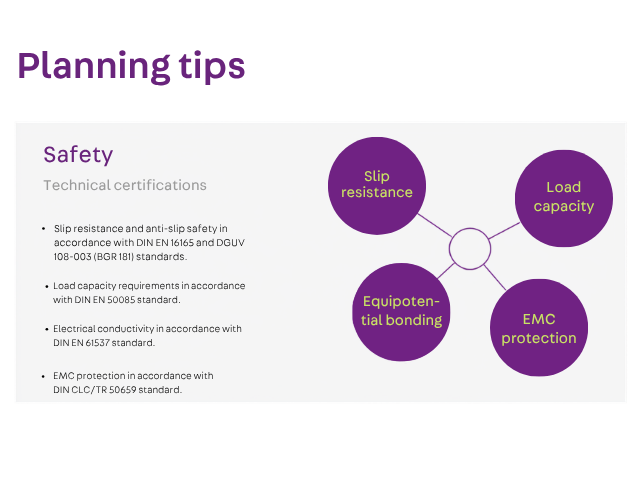
For this reason, the cover must be selected by reviewing its slip resistance class. PohlCon RHP covers with anti-slip embossing achieve class R11 in accordance with the DIN EN 16165 standard for slip resistance and DGUV 108-003.
In industrial plants, this aspect directly affects the safety of the people working in the installation.
Mechanical protection of cabling
One of the main reasons for installing an industrial walkable floor duct is to protect cabling against external influences. In an industrial plant, cables may be exposed to impacts, sparks, dirt, dust, vibrations or maintenance work.
A closed and robust system helps reduce this risk. It also keeps the lines organised inside the duct and prevents cables from being scattered, loose or insufficiently protected.
This protection is especially relevant when cabling forms part of critical processes. In an automated production line, a cabling incident can stop a machine, a robotic cell or part of the production line.
Electromagnetic compatibility
Electromagnetic compatibility, or EMC, is becoming increasingly important in industrial installations. In plants with motors, frequency converters, automation, sensors, electrical panels and communication systems, electromagnetic interference can affect the correct operation of equipment.
For this reason, it is advisable to check whether the routing system has been tested or verified for EMC protection. In PohlCon walkable floor ducts, EMC protection is verified in accordance with DIN CLC/TR 50659.
From a project perspective, this helps design safer and more coherent routes when power, data and control lines coexist.
Electrical conductivity and equipotential bonding
In industrial electrical installations, the cable management system must be correctly integrated into the protective measures. Equipotential bonding and earthing are essential aspects for protecting people and avoiding dangerous potential differences.
PohlCon walkable floor ducts have been tested for electrical conductivity in accordance with DIN EN 61537 for cable management systems. They also incorporate pre-punched side holes that allow elements such as equipotential bonding components to be fixed.
On site, this type of solution facilitates the installer’s work and allows the duct to be integrated into the installation’s protective network in a more orderly way.
Materials and corrosion protection
The environment has a major influence on the choice of material and coating. Installing a walkable duct in a dry industrial hall is not the same as installing it in an area with humidity, an aggressive atmosphere, chemicals or exposure to corrosive agents.
In industrial projects, we always recommend reviewing:
- the corrosivity category of the environment
- humidity
- presence of chemical agents
- frequent cleaning
- exposure to salinity
- temperature
- requirements of the production process
BK walkable floor ducts are available in Sendzimir hot-dip galvanised steel in accordance with DIN EN 10346. For other cable management systems, PohlCon also offers solutions in different coatings and materials, including specific options for more demanding environments.
Industrial walkable floor ducts in automotive and production lines
Automotive is a particularly demanding sector for industrial cabling. Production lines usually integrate robots, conveyors, assembly stations, control systems, electrical panels, sensors, pneumatic equipment and multiple cable routes.
In these environments, the floor is not a secondary space. It is an active part of the production process. That is why any system installed at floor level must perform several functions at once:
- protect the cabling
- facilitate access to the lines
- withstand technical foot traffic
- avoid trip hazards
- allow branches and changes of direction
- integrate with machinery and auxiliary equipment
- maintain electrical safety
- facilitate future modifications
What we have seen in this type of project is that improvisation in cable routing ends up creating maintenance problems. When lines are not properly protected or suitable routes have not been planned, any later extension or modification becomes slower and less safe.
An industrial walkable floor duct allows work to be carried out with a more orderly logic. The cable remains protected, the route is clearer and the system can be adapted using formed parts, bends, branches, crossovers, reducers or telescopic inserts.
The importance of formed parts and accessories
An industrial routing system is not defined only by the straight section. On site, challenges appear at changes of direction, machine connections, side branches, crossovers and length adjustments.
That is why, when choosing industrial walkable floor ducts, it is important to review the availability of formed parts and accessories.
In the PohlCon BK system, the range includes solutions such as:
- 90° bends
- 45° bends
- variable bends from 0° to 90°
- T-branches
- variable branches
- crossovers
- reducers
- inside riser bends
- telescopic inserts
- separators
- connectors
- support profiles
- supports for elevation
- equipotential bonding components
The telescopic insert is especially useful when length adjustments are needed on site, as it allows differences to be compensated without always relying on manual cutting. This type of element reduces assembly times and facilitates later modifications.
In our experience, the more complex the route, the more important it is to work with a complete system. An industrial installation is rarely solved only with straight sections and covers. The real value lies in being able to adapt the route without losing safety, accessibility or technical coherence.
Common mistakes when choosing industrial walkable floor ducts
In floor-level cable routing projects, some mistakes are repeated frequently. They may seem minor during purchase, but they can affect installation, maintenance or the safety of the system.
Choosing a light-duty cable floor cover for an industrial application
The first mistake is using a conventional cable floor cover in an area that requires a walkable industrial system. If there is machinery, technical traffic, critical supply cables or a need for inspection, a light-duty solution may fall short.
Resistance is only one part of the issue. System stability, slip safety, electrical continuity, integration capacity and the availability of accessories also come into play.
Not anticipating changes of direction or branches
Another common mistake is calculating linear metres without reviewing the full route. In the plant, cabling has to adapt to machines, passageways, equipment, pillars, work areas and future extensions.
Good design should anticipate changes of direction, crossovers and branches before the solution is selected.
Not reviewing loads and supports
A walkable cover alone does not guarantee that the entire system will work correctly. Load capacity depends on the full configuration. Installation instructions, support spacing, use of separators and compartment limits must be respected.
In industrial systems, these details should be defined before moving on to the order or assembly stage.
Not considering slip safety
Industrial flooring may be exposed to conditions that increase the risk of slipping. For this reason, it is advisable to review the slip resistance class of the covers.
In technical walkways, a cover with anti-slip embossing can be much more suitable than a smooth surface.
Forgetting equipotential bonding
Equipotential bonding forms part of the electrical safety of the installation. If the metal duct is integrated into an industrial electrical system, its connection to the protective network must be considered according to the corresponding technical design.
The pre-punched side holes and specific accessories facilitate this integration and avoid improvised solutions.
How to choose between a cable floor cover and a walkable cable tray
The decision depends on the actual use. Not every floor-level route needs a walkable cable tray, but not every route can be solved with a cable floor cover either.
A cable floor cover may be sufficient when:
- the route is short
- the cabling is light-duty
- the installation is temporary
- there are no major mechanical requirements
- the environment is not a severe industrial environment
- complex technical integration is not required
An industrial walkable floor duct or walkable cable tray is more advisable when:
- the route forms part of a permanent installation
- there are power, data, pneumatic or hydraulic lines
- there is technical foot traffic
- the system must protect against impacts, dirt or sparks
- branches, crossovers or changes of direction are required
- the installation must be inspectable
- there are slip safety requirements
- electrical conductivity or equipotential bonding must be considered
- the project is in automotive, automated production or an industrial plant
In our case, when we analyse a project, we do not start only with the product. We first review the environment, the use of the route, the type of cabling, the maintenance requirements and the safety conditions. From there, we define whether a technical floor duct, a walkable cable tray or another cable management solution is most suitable.
If you need a broader view of materials, tray types and selection criteria, you can also consult our article on metal cable trays.
PohlCon BK walkable floor ducts
PohlCon BK walkable floor ducts are designed for routing cables and supply lines at floor level in industrial halls, production plants, machine building, industrial plants and automotive facilities.
The range includes BK 100 and BK 110 versions, with side heights of 100 mm and 110 mm respectively, and available widths from 100 to 600 mm. The system incorporates pre-punched side holes every 100 mm to facilitate the fixing of elements such as equipotential bonding components.
Its main technical features include:
- design for floor-level cable routing
- closed system for protection against dirt, sparks and mechanical influences
- walkable covers with load capacity of up to 5 kN, depending on the version
- covers with slip resistance class up to R11
- electrical conductivity tested in accordance with DIN EN 61537
- EMC protection in accordance with DIN CLC/TR 50659
- Sendzimir galvanising in accordance with DIN EN 10346
- formed parts for changes of direction, crossovers and branches
- accessories for support, elevation, fixing and equipotential bonding
- special solutions available on request
For us, one of the main advantages of the system is its comprehensive approach. The duct is conceived as a set of components that can solve real routes in the plant.
What to review before requesting technical advice
Before selecting an industrial walkable floor duct, it is advisable to gather minimum project information. This speeds up the technical recommendation and helps avoid sizing errors.
The most useful data are:
- type of installation
- sector and use of the area
- approximate route
- type of cables or lines to be routed
- available floor width
- expected traffic
- need for anti-slip covers
- presence of humidity, dust, dirt or corrosive agents
- cable entry and exit points
- need for branches or crossovers
- maintenance requirements
- possible future extensions
- electrical safety conditions
With this information, the technical analysis can assess whether a standard system, a configuration with specific formed parts or a special solution adapted to the project is required.
A system designed for real industrial installations
Industrial walkable floor ducts make sense when floor-level cabling must form part of a safe, maintainable installation prepared for demanding environments. In these cases, choosing a light-duty solution may appear sufficient at the beginning, but it can create limitations when loads, changes of direction, maintenance, slip safety or electrical integration become relevant.
At PohlCon Ibérica, we recommend analysing each project from the reality of the installation: which lines need to be routed, what risks exist in the environment, how maintenance will be carried out and what level of safety the system must offer over the long term.
If you are assessing a solution for floor-level cable routes in an industrial plant, a production line or an automotive project, our technical team can help you define the most suitable system according to the route, loads, environment and real needs of the installation.