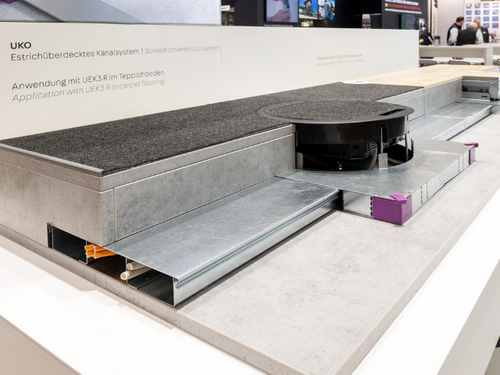
Screed-covered underfloor duct system, the new UKO range for flexible offices
In many tertiary buildings, the challenge is not only carrying power and data, but doing it properly without overcrowding ceilings, walls or walkways with visible runs. When workstation distribution changes, cabling grows and connection needs evolve, a screed-covered underfloor duct system stops being an aesthetic alternative and becomes a technical decision.
This is where it makes sense to talk about UKO, our new range for screed-covered underfloor ducting. Not as an isolated novelty, but as a solution designed for offices, exhibition areas and technical-use spaces where both the initial installation and the capacity for later expansion matter.
In our technical documentation you can see how our new UKO range allows cables to be laid before the screed is poured, provides spare capacity for future extensions, is available in 2- and 3-compartment versions and complies with DIN EN 50085-2-2.
In our previous article on underfloor systems, we already explained the overall view of the system, planning, regulations and its applications across different sectors. In this new content, we move to a more specific point: what a screed-covered underfloor duct system adds, when it makes sense to specify it and why our new UKO range is particularly well suited to offices and technical areas.
When a screed-covered system offers more than a generic ducting solution
There are projects where perimeter or overhead distribution remains the most suitable option. But there are also many where that approach starts to fall short.
In corporate offices, for example, workstation redistribution is constant. Teams change, collaborative areas grow, new power and data needs appear and, if the infrastructure does not anticipate them, every change forces improvisation. In exhibition areas, flexibility is even more important. Service points need to appear where the space requires them, not only where it was easiest to install them at the beginning. In technical rooms and support areas, the value lies in having an infrastructure that is inspectable, orderly and expandable, not simply hiding cables.
That is why this type of system should not be approached as a simple duct hidden under the floor. It should be understood as an infrastructure that makes it possible to distribute power and data in an orderly way, maintain accessibility and facilitate future adaptations without having to redo the installation.
What UKO solves in design and on site
The strength of UKO lies in the fact that we are not talking about a single part, but about a complete screed-covered ducting system designed to feed floor boxes and service units. In our documentation you can see that we have developed this range for office areas, exhibitionspaces and technical-use areas, with simple installation, sufficient reserve even for large cable quantities and adaptation to different room sizes and installation requirements.
Cables can be laid before the screed is poured
With UKO, we can lay cables before the screed is poured. This makes on-site coordination easier, speeds up installation phases and avoids dependence on more rigid sequences when the project is working to tight deadlines.
Installation is faster with screed boxes and formwork
Our technical documentation also shows a faster installation thanks to screed boxes with formwork. This point is especially useful when the site requires precision, cleanliness and execution that is well coordinated with the other trades.
The system is suitable for different screeds and floor coverings
In office projects and technical spaces, the relationship between the ducting system and the final floor finish is decisive. With UKO, we have a solution suitable for different types of screed and floor covering, which provides flexibility when the project needs to adapt to different flooring configurations.
We can choose between 2 and 3 compartments
The UKO range is available in 2 and 3compartment versions, which makes it possible to organise the distribution of power and data more effectively and adapt the system to simpler or more demanding needs.
The duct volume is designed to grow
Another important point is expansion capacity. With UKO, we are not thinking only about the initial installation. We also leave room for future extensions, something especially useful in offices, technical areas and spaces that change over time.
It is compatible with our service units
Compatibility with our service units reinforces the logic of a complete system. In this type of solution, that consistency between ducting, openings and service points is key so that the installation works well from day one and remains useful over time.
Flooring, floor coverings and flexibility of use
In a screed-covered underfloor ducting solution, the system cannot be designed without taking the building’s final finish into account. Flooring, floor covering, available height and the position of openings all form part of the same decision.
With UKO, we respond to this need with a solution suitable for different types of screed and floor covering. This makes it possible to integrate it into projects where the floor finish may vary from one area to another or where it is useful to maintain some flexibility if design decisions change during the works.
This is one of the keys to the system. It is not simply about passing beneath the floor. It is about integrating the ducting with the real use of the space, with the final finish and with the way that building will operate over the years.
When this is not resolved properly, problems appear that often arrive too late: poorly located openings, incompatibilities with the flooring, awkward maintenance or a lack of capacity for future expansion. That is why it is worth defining these issues during the design stage and not leaving them until installation.
2 or 3 compartments, a decision that changes far more than it seems
On many projects, this choice is made late or simply by habit. And that almost always proves expensive.
With UKO 2 and UKO 3, we can work with a much more orderly design logic. We can choose two compartments when distribution is simpler or three compartments when the segregation between power, data or other services requires a higher level of organisation. The range includes several combinations of height and width, 3-meter ducts and round or square opening boxes depending on the selected configuration.
With UKO 2, we have widths of 190 and 250 mm and heights of 28, 38, 48 and 58 mm. With UKO 3, we work with widths of 250 and 350 mm and the same base height. To this we add round and square screed boxes, vertical bends and installation accessories.
All this has direct consequences for the project:
- it defines the real level of segregation
- it conditions the available spare capacity for growth
- it influences the most suitable type of opening
- it affects coordination with boxes and service units
- it improves the system's ability to adapt to future changes
When an office or a technical room is reviewed after a few years, this decision between 2 or 3 compartments can make the difference between expanding normally and having to redo part of the installation.
What should be defined before specifying a screed-covered system
If we want the ducting to perform well on site and in everyday use, there are several issues that should be resolved before going down to a specific reference.
First, the geometry of the project
Available height, useful width, box position, route direction and real spare cable capacity. Without this, the specification remains incomplete.
Second, the type of use
A corporate office with frequent workstation changes is not the same as a technical room where inspectability is the priority. Nor is an exhibition space the same as a more stable-use area.
Third, the type of flooring and floor covering
If this is not properly defined, incompatibilities appear later, just when it is least desirable to correct them.
Fourth, the quantity and type of cabling
In our UKO documentation, the range is prepared to accommodate even large quantities of cables. That argument only has value when it is translated into a design decision and not left to a quick estimate.
Fifth, the opening strategy
UKO incorporates screed boxes with round and square openings. Choosing one or the other is not a minor matter. It affects the layout, accessibility and the way the system integrates with the workstation or service area.
What mistakes make an underfloor installation more expensive before it shows
There are mistakes that do not create problems on the first day, but do over the entire service life of the installation.
The first is undersizing spare capacity. If the system is full from the start, every future extension becomes awkward.
The second is failing to decide segregation properly. When power and data coexist without clear criteria, the installation loses order and maintenance becomes more difficult.
The third is leaving boxes and openings too open to site decisions. The less that is defined in the design, the more improvisation moves into installation.
The fourth is forgetting the coordination between the screed and the flooring. This type of system does not work well when the electrical work and the civil work move forward separately.
The fifth is failing to close down installation details. In our installation instructions, we indicate very specific operations, such as positioning the screed box according to the drawings, aligning it, securing it to the slab, adjusting the duct to the required length, removing burrs from the cut and applying cold galvanizing to the cut edge. They are small details, but they are what turn a good solution into a good installation.
How UKO fits into our underfloor ecosystem
UKO does not arrive to replace the general conversation about underfloor systems. It arrives to strengthen a very specific part of the solution: the one in which the project needs a screed-covered underfloor ducting system, integration with flooring and floor coverings, room for future expansion and an orderly distribution for offices, exhibition spaces or technical rooms.
In our previous article, we already spoke about the regulatory basis, planning and sector-specific applications of underfloor systems. This new content focuses on a more specific solution within that same ecosystem. In this way, each article responds to a different need and adds value from a different angle.
If you want to start from a broader view of the system, you can consult our advanced guide to underfloor systems.
And if you are already evaluating a specific solution for a project with screed, UKO allows you to take that step with a proposal that is more closely focused on the real project.
From solution to real project
When an office is redesigned, when a technical room needs more service points or when a flexible space must adapt to new uses, the problem is rarely obtaining the material. The problem lies in having left an infrastructure that is too rigid.
That is where a well-chosen screed-covered underfloor duct system makes a difference. Not because it hides cables better, but because it leaves the building prepared to change without suffering through every modification.
With UKO, we bring together several of the arguments that provide the most value in this type of work today: simpler installation, expansion capacity, compatibility with different floorings and floor coverings, 2 and 3 compartment options, dedicated screed boxes and a system logic that fits electrical and data distribution in offices, exhibition areas and technical spaces.
If you are evaluating an underfloor solution for a new project or a refurbishment and want to go beyond generic ducting, it makes sense to review from the start the geometry, the type of compartmentalisation, the position of openings, the final floor finish and the spare capacity needed for future growth.
And if you first want a broader view of the overall system, we recommend consulting our advanced guide to underfloor systems, where we explain the general framework, the regulations and the sector-specific applications of the system.
When a screed-covered system offers more than a generic ducting solution
There are projects where perimeter or overhead distribution remains the most suitable option. But there are also many where that approach starts to fall short.
In corporate offices, for example, workstation redistribution is constant. Teams change, collaborative areas grow, new power and data needs appear and, if the infrastructure does not anticipate them, every change forces improvisation. In exhibition areas, flexibility is even more important. Service points need to appear where the space requires them, not only where it was easiest to install them at the beginning. In technical rooms and support areas, the value lies in having an infrastructure that is inspectable, orderly and expandable, not simply hiding cables.
That is why this type of system should not be approached as a simple duct hidden under the floor. It should be understood as an infrastructure that makes it possible to distribute power and data in an orderly way, maintain accessibility and facilitate future adaptations without having to redo the installation.
What UKO solves in design and on site
The strength of UKO lies in the fact that we are not talking about a single part, but about a complete screed-covered ducting system designed to feed floor boxes and service units. In our documentation you can see that we have developed this range for office areas, exhibitionspaces and technical-use areas, with simple installation, sufficient reserve even for large cable quantities and adaptation to different room sizes and installation requirements.
Cables can be laid before the screed is poured
With UKO, we can lay cables before the screed is poured. This makes on-site coordination easier, speeds up installation phases and avoids dependence on more rigid sequences when the project is working to tight deadlines.
Installation is faster with screed boxes and formwork
Our technical documentation also shows a faster installation thanks to screed boxes with formwork. This point is especially useful when the site requires precision, cleanliness and execution that is well coordinated with the other trades.
The system is suitable for different screeds and floor coverings
In office projects and technical spaces, the relationship between the ducting system and the final floor finish is decisive. With UKO, we have a solution suitable for different types of screed and floor covering, which provides flexibility when the project needs to adapt to different flooring configurations.
We can choose between 2 and 3 compartments
The UKO range is available in 2 and 3compartment versions, which makes it possible to organise the distribution of power and data more effectively and adapt the system to simpler or more demanding needs.
The duct volume is designed to grow
Another important point is expansion capacity. With UKO, we are not thinking only about the initial installation. We also leave room for future extensions, something especially useful in offices, technical areas and spaces that change over time.
It is compatible with our service units
Compatibility with our service units reinforces the logic of a complete system. In this type of solution, that consistency between ducting, openings and service points is key so that the installation works well from day one and remains useful over time.
Flooring, floor coverings and flexibility of use
In a screed-covered underfloor ducting solution, the system cannot be designed without taking the building’s final finish into account. Flooring, floor covering, available height and the position of openings all form part of the same decision.
With UKO, we respond to this need with a solution suitable for different types of screed and floor covering. This makes it possible to integrate it into projects where the floor finish may vary from one area to another or where it is useful to maintain some flexibility if design decisions change during the works.
This is one of the keys to the system. It is not simply about passing beneath the floor. It is about integrating the ducting with the real use of the space, with the final finish and with the way that building will operate over the years.
When this is not resolved properly, problems appear that often arrive too late: poorly located openings, incompatibilities with the flooring, awkward maintenance or a lack of capacity for future expansion. That is why it is worth defining these issues during the design stage and not leaving them until installation.
2 or 3 compartments, a decision that changes far more than it seems
On many projects, this choice is made late or simply by habit. And that almost always proves expensive.
With UKO 2 and UKO 3, we can work with a much more orderly design logic. We can choose two compartments when distribution is simpler or three compartments when the segregation between power, data or other services requires a higher level of organisation. The range includes several combinations of height and width, 3-meter ducts and round or square opening boxes depending on the selected configuration.
With UKO 2, we have widths of 190 and 250 mm and heights of 28, 38, 48 and 58 mm. With UKO 3, we work with widths of 250 and 350 mm and the same base height. To this we add round and square screed boxes, vertical bends and installation accessories.
All this has direct consequences for the project:
- it defines the real level of segregation
- it conditions the available spare capacity for growth
- it influences the most suitable type of opening
- it affects coordination with boxes and service units
- it improves the system's ability to adapt to future changes
When an office or a technical room is reviewed after a few years, this decision between 2 or 3 compartments can make the difference between expanding normally and having to redo part of the installation.
What should be defined before specifying a screed-covered system
If we want the ducting to perform well on site and in everyday use, there are several issues that should be resolved before going down to a specific reference.
First, the geometry of the project
Available height, useful width, box position, route direction and real spare cable capacity. Without this, the specification remains incomplete.
Second, the type of use
A corporate office with frequent workstation changes is not the same as a technical room where inspectability is the priority. Nor is an exhibition space the same as a more stable-use area.
Third, the type of flooring and floor covering
If this is not properly defined, incompatibilities appear later, just when it is least desirable to correct them.
Fourth, the quantity and type of cabling
In our UKO documentation, the range is prepared to accommodate even large quantities of cables. That argument only has value when it is translated into a design decision and not left to a quick estimate.
Fifth, the opening strategy
UKO incorporates screed boxes with round and square openings. Choosing one or the other is not a minor matter. It affects the layout, accessibility and the way the system integrates with the workstation or service area.
What mistakes make an underfloor installation more expensive before it shows
There are mistakes that do not create problems on the first day, but do over the entire service life of the installation.
The first is undersizing spare capacity. If the system is full from the start, every future extension becomes awkward.
The second is failing to decide segregation properly. When power and data coexist without clear criteria, the installation loses order and maintenance becomes more difficult.
The third is leaving boxes and openings too open to site decisions. The less that is defined in the design, the more improvisation moves into installation.
The fourth is forgetting the coordination between the screed and the flooring. This type of system does not work well when the electrical work and the civil work move forward separately.
The fifth is failing to close down installation details. In our installation instructions, we indicate very specific operations, such as positioning the screed box according to the drawings, aligning it, securing it to the slab, adjusting the duct to the required length, removing burrs from the cut and applying cold galvanizing to the cut edge. They are small details, but they are what turn a good solution into a good installation.
How UKO fits into our underfloor ecosystem
UKO does not arrive to replace the general conversation about underfloor systems. It arrives to strengthen a very specific part of the solution: the one in which the project needs a screed-covered underfloor ducting system, integration with flooring and floor coverings, room for future expansion and an orderly distribution for offices, exhibition spaces or technical rooms.
In our previous article, we already spoke about the regulatory basis, planning and sector-specific applications of underfloor systems. This new content focuses on a more specific solution within that same ecosystem. In this way, each article responds to a different need and adds value from a different angle.
If you want to start from a broader view of the system, you can consult our advanced guide to underfloor systems.
And if you are already evaluating a specific solution for a project with screed, UKO allows you to take that step with a proposal that is more closely focused on the real project.
From solution to real project
When an office is redesigned, when a technical room needs more service points or when a flexible space must adapt to new uses, the problem is rarely obtaining the material. The problem lies in having left an infrastructure that is too rigid.
That is where a well-chosen screed-covered underfloor duct system makes a difference. Not because it hides cables better, but because it leaves the building prepared to change without suffering through every modification.
With UKO, we bring together several of the arguments that provide the most value in this type of work today: simpler installation, expansion capacity, compatibility with different floorings and floor coverings, 2 and 3 compartment options, dedicated screed boxes and a system logic that fits electrical and data distribution in offices, exhibition areas and technical spaces.
If you are evaluating an underfloor solution for a new project or a refurbishment and want to go beyond generic ducting, it makes sense to review from the start the geometry, the type of compartmentalisation, the position of openings, the final floor finish and the spare capacity needed for future growth.
And if you first want a broader view of the overall system, we recommend consulting our advanced guide to underfloor systems, where we explain the general framework, the regulations and the sector-specific applications of the system.