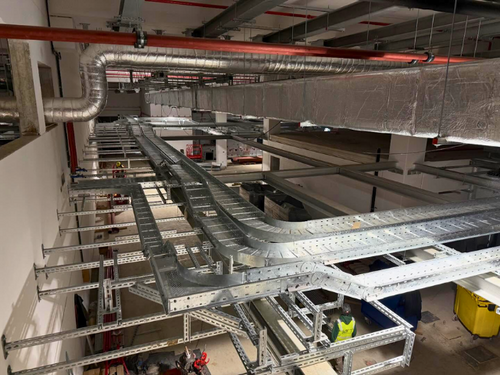
Well-distributed energy in industry, the industrial electrical cable containment that prevents downtime and supports growth
In industry, downtime rarely comes with a big warning. It usually starts as something small, a quick expansion, a new run squeezed in wherever it fits, a branch solved on site because the project was tight. A few months later the symptoms appear, slow interventions, more intermittent incidents, more time tracing routes, and more pressure on maintenance.
After seeing it across very different projects, the pattern repeats. Many plants invest in equipment, control, efficiency or self-consumption, yet they still treat industrial electrical cable containment as a minor topic. In 2026 that no longer works, because energy inside the plant is managed as a living system. It changes, adapts, grows, and becomes digital.
Cable containment is the route. If the route is at its limit from day one, any improvement becomes fragile.
Why, in 2026, cable containment stops being a minor detail
For years, the focus was on contracted power, producing, and maintaining. Today, extra layers put the installation under tension.
Self-consumption and new sources within the site.
More sensors, more communications, and more data.
Layout changes, line expansions, and more frequent reorganizations.
Industry does not have an abstract energy problem. In many cases it has a distribution problem inside the plant. And that problem is rarely in the switchboard. It is usually on the route.
This is where the approach changes. The useful question is no longer what material to use, but whether the infrastructure allows you to operate, maintain, and grow without falling into patch mode.
What fails on the route, not on the switchboard
An installation can have a solid electrical design on paper and still become hard to maintain because of how the containment is executed. We have seen routes that looked correct on drawings, but on site ended up being resolved with small changes that did not seem serious. In the end, the serious part was not the change itself, it was the accumulation.
The typical outcome is a containment route that.
- forces you to dismantle to carry out an intervention
- mixes power and signal without clear criteria
- leaves no physical room to grow
- creates hot spots due to uncontrolled grouping
- and turns every expansion into a mini construction job
When that happens, energy stops being a controllable asset and becomes a source of uncertainty.
Three trends that put cable containment at the center
Self-consumption with distributed power inside the plant
Industrial self-consumption has made it normal for new lines, new protections, new panels and new routes to appear. The question is not whether expansion will come, but when.
If containment is sized only for today, the future is paid for with improvisation. Sections get added, routes cross wherever they can, and order is lost. When the design includes reserve capacity, planned routes and clear branching points, expansions stop being traumatic.
Variability and flexibility, stability is designed
The variability of a source like solar is not the problem itself. The problem is a rigid installation with no capacity to absorb changes without reworking routes.
In a plant, flexibility shows up in very specific decisions. Accessibility, segregation, and the ability to expand without having to dismantle. It sounds basic, but it is exactly what gets sacrificed when cable containment is treated as a secondary line item.
Digitalization and predictive maintenance
Digitizing energy means measuring, recording and acting. That brings control wiring, communications and sensors, and it also brings a practical consequence, intermittent faults. They are the most expensive because they are hard to diagnose.
When power, control and data coexist without criteria, the system becomes more sensitive. It does not fail all the time, but when it does, diagnosis time goes up and maintenance becomes more expensive.
What a well-designed industrial electrical cable containment system delivers
Operational continuity, less downtime from avoidable issues
On site, failure is rarely a single component. It is usually a combination of small factors, tight support, a poorly chosen joint, an exposed section, or an improvised level change.
A properly sized containment route reduces damage from vibration, rubbing and mechanical stress, and it also reduces weak points that end up causing downtime over time. Operational continuity is built by repeating the right details consistently.
Faster maintenance, access and traceability
Maintenance is paid for in time. When the route is accessible and well organized, finding, intervening and closing is faster. When it is saturated, crossed or hidden, the team loses time and makes more mistakes.
In our experience, the quality leap does not come from one big technical gesture. It comes from discipline. Clear routes, coherent supports, radii and level changes solved with the right parts, and basic labelling that prevents searching.
Growth with less friction
Plants change. And when they do, containment decides whether the expansion is a clean improvement or a conflict.
Designing with margin means leaving physical capacity, anticipating branches and ensuring the system can be extended without breaking the overall logic. This is not blind oversizing; it is designing around a realistic growth hypothesis.
Safety and compliance
From a regulatory and safety perspective, the practical goal is to avoid fragile installations. Working with tested systems and clear installation criteria helps keep component coherence. For cable trays and ladder trays, the usual reference is UNE-EN IEC 61537.
And for the general framework of low-voltage installations, it is useful to keep the ITC-BT technical guide at hand.
How to design industrial electric cable containment for 2026
This is where the concept comes down to real decisions. There is no need to overcomplicate it, but there does need to be order.
1. Start with the route and growth, not the price per meter
Before choosing the type, define the route, branching points and growth margin. In real projects, what often fails is closing purchasing decisions without closing criteria. Then changes arrive and the system becomes mixed, with parts from here and there.
If the project will grow, the cable containment must allow it without forcing you to redo half the plant.
2. Choose containment type based on environment and real use
Online it is common to find articles that classify containment by material and conduct type, such as PVC, IMC or EMT. That is useful as a starting point, but in industry you usually need to go one level deeper. Which option fits the environment, accessibility and maintenance.
You will also see many shop categories that group conduits and trunking such as corrugated conduit, PVC or cable ducting. Others list metallic conduit such as EMT and accessories. The problem is that these categories do not tell you how to prevent downtime, they only tell you what exists.
In a plant, the decision often sits between open, inspectable systems and more closed or protected systems. This is where cable tray systems come in as a strong option when you need order, accessibility and the ability to expand.
Here are a few previous posts that can help depending on your case.
- If you prioritize ventilation, accessibility and fast interventions, an open solution like wire mesh often fits. For examples and details, it is best to go to the specific guide.
https://pohlcon.es/empresa/noticias/detail/bandejas-portacables-de-rejilla-puk-ideales-para-calor-alta-ventilacion-y-entornos-exigentes - If loads, spans and structural requirements lead the decision, a ladder tray is often the most suitable option.
https://pohlcon.es/empresa/noticias/bandejas-escalera-para-cables - If you need more protection against falling particles or tougher environmental demands, the logic of perforated vs solid-bottom trays comes into play, with their differences.
https://pohlcon.es/empresa/noticias/detail/bandeja-para-cables-perforada-o-ciega-diferencias-usos-y-ventajas
The idea is simple. Containment must respond to how you operate, not to what happens to be available on site that day.
3. Support design defines the system’s service life
On site you can tell immediately when supports were left for the end. Vibration appears, deflection, forced joints and weak points.
A well-planned support system provides stability, durability and easier maintenance. It also reduces the number of future interventions due to deformation or readjustments. It is the least visible part, yet it often conditions the result the most.
4. Accessories planned from the design stage
Bends, branches, level changes, joints. If it is solved on site in an improvised way, you pay for it in order and time.
We have come across installations that worked but depended on quick decisions. As soon as you need to expand or intervene, it shows. It becomes harder to follow the route and harder to keep coherence.
Planning accessories from the design stage increases consistency and reduces rework. In industry, rework translates into lost hours and higher costs.
5. Real segregation between power, control and data
When power, control and communications travel without criteria, maintenance gets complicated and hard-to-reproduce problems appear. Separating routes, defining distances and keeping discipline in installation reduces improvised decisions that end up affecting performance.
There is no need to turn this article into a treatise, but it is worth stating one thing clearly. Digitalization increases sensitive wiring, and it deserves the importance it has.
6. When the building requires it, underfloor routes and points of use
In some plants or buildings, part of the value lies in bringing energy and services closer to the work point through underfloor solutions or raised floors, with controlled and tidy access.
Here, too, there is a containment criterion. It is not a decorative extra. It is a different way of distributing cabling, especially useful when the layout changes or when you want to free up ceilings and walls, either because you need the space or because you want a cleaner finish.
Two clear signs your containment route needs a review
- Every intervention requires dismantling more than is reasonable, because the route is not accessible or is saturated.
- Every expansion force improvisation, because there is no space reserve, there are no clear branching points, or the system does not allow coherent growth.
When either of these happens, you are usually already paying for containment in maintenance time and operational risk.
From theory to site, the value of technical support
The goal in 2026 is not to stack technologies. It is to design a coherent system where everything works in a coordinated way.
In cable containment, that translates into something very practical. Applied engineering and technical support to make decisions with clear criteria, optimize routes, and make sure the installation reaches site with clear decisions. That is the difference between a plant that is maintained normally and one maintained through improvisation.
If you are reviewing a new project or an expansion and you want to validate criteria for containment, supports, segregation and growth margin, our technical team can help you land it with diagrams, solutions and an installation approach designed to avoid setbacks. You can contact them here.
If you still have doubts, ask yourself these questions.
Practical checklist to assess whether your containment route is ready to grow
- Do you have capacity margin to grow without reworking routes?
- Are the supports engineered, or were they solved by habit?
- Are power, control and data segregated with clear criteria?
- Are branches and bends defined in the design?
- Is the installation accessible for maintenance without unnecessary dismantling?
- Does the chosen system work as a set, with coherent and tested components?
When these answers are solid, energy stops being a source of incidents and becomes a manageable, well-organized infrastructure, which is exactly what industry needs in 2026.