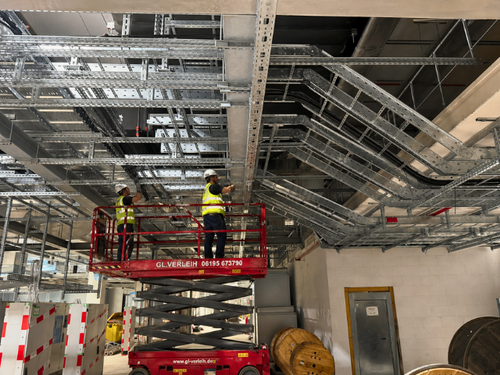
REBT 2026 Updates, How They Affect Installers, Cable Trays and PV Systems
Talking about REBT 2026 updates is no longer just about reviewing a list of regulatory changes. For professionals who design, install or inspect electrical systems, the real question is different. Which on-site decisions should be reviewed now in order to avoid corrections, rework or problems during inspection. That is where cable routing, cable trays, material selection, surge protection, direct current and photovoltaic systems come fully into play.
There is also a key nuance that should be clarified from the start. When the sector talks about REBT 2026, two different layers are often mixed together. On one side, there is the current REBT framework already in force. On the other, there is the broader reform process that introduces updates to several technical instructions and adds the new ITC-BT-53 for installations using direct current systems.
The most useful way to approach this topic is to separate what is already in force, what the UNE standards update has already consolidated and what installers should start anticipating because the reform is clearly moving in that direction.
What is already in force and what is still part of the reform process
The current starting point is the consolidated REBT text and its standards update through ITC-BT-02. That 2025 update includes standards that are especially relevant for this article, such as UNE-EN 61537 for cable tray and cable ladder systems, UNE-HD 60364-5-52 for wiring systems, UNE-HD 60364-5-54 for earthing and protective conductors and UNE-HD 60364-7-712 for solar photovoltaic power supply systems. It also incorporates standards that are closely linked to photovoltaic safety, such as UNE-EN 61643-31, UNE-EN IEC 61914 and UNE-EN IEC 63027.
At the same time, the Ministry opened a broader reform process to adapt the regulation to the new reality of self-consumption, energy storage and more demanding direct current installations. That process makes one direction very clear. The sector is moving towards greater technical requirements in direct current, documentation, inspections and surge protection, with ITC-BT-53 as the most visible new piece.
For installers, the consequence is straightforward. It is no longer enough to wait until a reform is fully published in the BOE before reviewing on-site criteria. Many of the requirements in the draft respond to real problems that are already appearing in photovoltaic installations, DC runs, metallic support structures and self-consumption expansions. The earlier those good practices are incorporated, the lower the risk of having to rework part of the installation later.
What changes in practice for installers
The first practical reading of REBT 2026 for installers is this. There is now more weight on documented safety, maintenance, surge protection, and the correct design of installations that include direct current and self-consumption. This is not a cosmetic shift. It is a change in criteria. What matters increasingly is that the installation works today and can also be verified, expanded, maintained and inspected tomorrow.
In the draft reform, for example, there is stronger emphasis on initial and periodic inspections. Regardless of the exact timing of each regulatory step, the trend is clear. Installations need to be prepared for stricter review, with more traceability and less improvisation.
The same is true for surge protection. The proposed new wording of ITC-BT-23 develops in greater detail the protection against transient and temporary overvoltages and links that protection more directly to boards, centralised systems and generation layouts. In other words, surge protection is no longer something to be added at the end. It becomes a basic design decision.
In self-consumption installations, the current framework is already demanding. Real Decreto 244/2019 amended ITC-BT-40 to make clear that interconnected self-consumption systems must include measures to limit direct current injection, prevent overvoltages and avoid island operation. For installations without surplus, the anti-export system must also meet the corresponding annex requirements. That is not just a future scenario. It is part of the current regulatory framework.
How this affects cable trays
This is one of the areas where the difference between a generic article and a useful guide for installers becomes obvious. Cable trays are not selected only by width, price or availability. The REBT requires the installer to consider the installation system, the type of cable, the environment, the maintenance requirements and, when relevant, the equipotential bonding continuity of the full assembly.
ITC-BT-20 expresses this in a practical way. Wiring systems must match the installation method and the type of conductor or cable used. In those tables, cables with sheath, both multicore and single-core, can be used on trays and ladder systems depending on the configuration. That changes a very common habit on site. The right question is not which tray fits the route best. The right question is whether that tray fits the cable type, the environment and the expected maintenance conditions.
In some cases, a perforated cable tray performs better because it offers heat dissipation and easier access. In other cases, an unperforated cable tray or a system with cover makes more sense because it offers greater protection against dust, splashes or external contaminants. Once the installation moves outdoors, the finish is no longer a secondary detail.
The 2025 update to ITC-BT-02 also reinforces the role of UNE-EN 61537 as the reference standard for cable trays and cable ladder systems, together with UNE-HD 60364-5-52 and UNE-HD 60364-5-54 for wiring systems and earthing. That means installers need to think about the tray as part of a complete system rather than as an isolated product line item.
At PohlCon Ibérica, this point fits perfectly with the way our product range is structured. Our cable management systems include mesh cable trays, perforated and unperforated cable trays, cable ladder trays, wide-span systems and fastening accessories, because the technically correct choice is rarely one tray for everything. It is usually a solution matched to the environment, the load, the ventilation needs and the level of protection required.
Outdoor environments, humidity and corrosion
One of the most common mistakes in installation work is to treat outdoor runs as if they were simply a more robust version of indoor ones. The REBT does not approach them that way. According to ITC-BT-30, outdoor installations are considered wet locations. This means wiring systems must be watertight, and terminals, joints and connections must be solved with systems offering IPX4 protection.
This does not mean that every open tray has to disappear outdoors. It means the installer has to analyse the full installation more carefully. A tray may still be the right solution to support and organise the route, but boxes, joints, derivations, accessories, materials and finishes must be selected according to humidity, dust, saline atmosphere, chemical exposure or solar radiation.
In that context, technical articles already published by PohlCon Ibérica on metal cable tray, PUK wire mesh cable trays and perforated or unperforated cable tray are a useful complement, because they help bring the regulatory criteria down to real design decisions involving ventilation, mechanical strength and corrosion behaviour.
Public-access buildings and critical routes
Another point installers should not overlook is the behaviour of the installation in demanding spaces such as public-access buildings, hospitals, tunnels or routes associated with safety services. The REBT already sets specific requirements in ITC-BT-28, and in those environments the cables must be non-fire propagating and have reduced smoke emission and low opacity.
For professionals working with cable trays and support systems, this changes the way specifications should be written. Not every combination of accessories is acceptable. On critical routes, what matters is the complete system, including tray, fastenings, supports, cable, and where required, criteria related to functional integrity or circuit continuity.
This is exactly the kind of context where it makes sense to review supporting content such as The importance of safety in cable management systems: regulations and standards, because it brings the regulation down to the practical level of materials, fire resistance and long-term durability.
The new ITC-BT-53 and its real impact on photovoltaics
If there is one part of the reform that matters most to installers, it is ITC-BT-53. The Ministry itself explained during the public consultation that the aim was to adapt the safety regulation to the new reality of widespread self-consumption by introducing a specific technical instruction for installations of direct current systems. The draft develops that instruction with dedicated sections on protection against electric shock, fire, overcurrents, overvoltages, equipment selection, wiring systems, switching and earthing.
The first practical consequence is that the DC side can no longer be treated as a grey area solved through habit. Direct current gains its own regulatory weight. That forces a review of everything from route layout and cable selection to protection, switching and the relationship between the inverter, the modules and the metallic structure.
The draft also includes several concrete points that are already worth considering. One of the clearest is that enclosures for electrical equipment installed outdoors should be at least IP44 and IK07. Another is that, for cables exposed to direct heating from the underside of photovoltaic modules, a minimum ambient temperature of 70 ºC should be considered when calculating current-carrying capacity. These are highly relevant details for rooftop as well as ground-mounted installations.
The same applies to surge protection in photovoltaics. The 2025 update to ITC-BT-02 already includes standards such as UNE-EN 61643-31 for photovoltaic SPDs, UNE-EN 62109-2 for inverter safety, UNE-EN 62116 for anti-islanding and UNE-EN IEC 63027 for DC arc detection and interruption. That raises the expected technical level on the DC side considerably.
What this means for metallic support structures and ground-mounted PV systems
This is a point that matters a great deal to the installer buyer persona and is rarely explained clearly enough. Support structures for solar panels should not be analysed only from a mechanical point of view. As soon as that metallic structure coexists with wiring systems, cable runs, earthing or equipotential connections, it becomes part of the electrical reasoning of the installation.
The draft of ITC-BT-53 is very explicit here. Whenever an equipotential bonding connection is required for photovoltaic metallic structures, all metallic support structures must be connected, including metallic wiring systems. If those structures are made of aluminium, the connection devices must take electrochemical pairs into account to ensure proper equipotential bonding.
That detail is especially important in ground-mounted photovoltaics, where the installation is exposed to outdoor conditions, thermal expansion, humidity, solar radiation and demanding maintenance cycles. A structure that is mechanically sound but poorly integrated from the point of view of routing and equipotential bonding tends to generate repeated incidents, slower diagnostics and higher operating costs.
At PohlCon Ibérica, we work precisely at that intersection between substructures for PV systems, cable management systems and sound installation criteria. Our experience in substructures for photovoltaic systems starts with site analysis, design, foundations and assembly, but it also includes a broader view of durability and system behaviour under demanding conditions.
What installers should already review
There are several decisions that are worth reviewing right now.
- How the route layout is being solved, especially in projects with self-consumption, future expansions, sensors or coexistence between power and signal.
- Which material and finish are being specified for outdoor use, humidity or corrosion.
- How equipotential bonding is being closed in trays, supports and metallic structures.
- Whether surge protection and DC-side switching are being considered from the design stage or left until the end.
A good installation is no longer just the one that fits the budget and works on commissioning day. A good installation is the one that allows maintenance, resists the environment, admits growth, passes inspection and reduces the need for patchwork on site six months later. That is the real background behind REBT 2026 updates.
Frequently asked questions about REBT 2026 updates
When will the new REBT be published?
As of today, the consolidated REBT text in the BOE shows its latest modification dated 3 September 2025. The broader reform that the sector associates with REBT 2026 was officially notified to the European Commission in July 2025 as a draft. It is important to distinguish between rules already in force and changes that are still in the approval process.
What role does ITC-BT-23 play in this update?
Surge protection gains much more weight. The draft modifies ITC-BT-23 and links it more directly to switchboards, centralised systems and generation layouts. In addition, the 2025 standards update already includes specific references to photovoltaic SPDs and related systems.
Does this affect cable trays and metallic supports?
Yes. UNE-EN 61537 remains the reference standard for cable trays and cable ladder systems, and the regulation requires wiring systems to be selected according to cable type and external influences. In photovoltaic installations and metallic routes, equipotential bonding and the earthing of the complete assembly become even more important.
What changes in photovoltaics?
The current framework already requires, through the amendment to ITC-BT-40, that interconnected self-consumption systems limit direct current injection, prevent overvoltages and avoid island operation. The future ITC-BT-53 goes deeper into DC-side safety, cables, outdoor enclosures, arc protection and the equipotential bonding of metallic structures.
Does it make sense to review installation criteria now?
Yes, especially in projects involving self-consumption, direct current, outdoor environments, planned expansions or demanding maintenance conditions. Many of the requirements in the draft respond to field problems that already exist today, so anticipating them improves the installation even before the reform is fully consolidated.
Closing remarks
For installers, REBT 2026 updates are not just a matter of regulatory theory. They are a reason to review how the real installation is designed and executed. Which tray is selected, which finish is specified, how outdoor routing is resolved, where the protections are placed, how the DC side is managed and how the equipotential bonding of supports and metallic structures is ensured.
When that part is done properly from the beginning, the installation gains in safety, maintenance, service life and room for growth. That is where a technical solution conceived as a complete system makes a real difference on site and later, when the time comes to expand, inspect or maintain the installation.