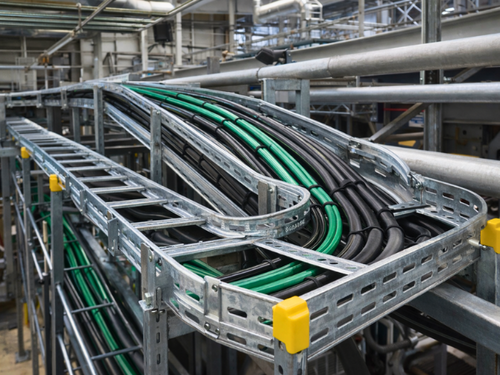
Cable ladder trays, a technical guide to choose, size and install on site
If you are comparing cable ladder trays, you typically already have a project with real demands: high loads, long spans, future extensions, heat, frequent maintenance or outdoor runs. In our experience, when a properly sized cable ladder tray is specified, the on-site result is cleaner and easier to maintain, and rework is reduced significantly due to better accessibility and lower risk of overloading the route.
This guide is written so you can make technical decisions with clear criteria: when a ladder tray makes more sense than a perforated tray or wire mesh, how to size it, which accessories define performance and which mistakes tend to appear during installation.
What a cable ladder tray is and when it makes sense
A cable ladder tray is a cable management system made of two side rails and cross rungs. This open geometry helps the cable load ventilate, stay accessible, and makes inspection or future extensions easier.
Typical cases where it performs especially well
- Runs with high power density where heat dissipation matters.
- Industrial plants with frequent extensions or route changes.
- Installations with long sections, high loads or the need to support heavy cable bundles.
- Technical areas where maintenance must be fast, without removing covers or opening closed trunking.
- Outdoor runs where water and dirt drainage improves reliability.
When another tray type may be a better choice
- If you need continuous protection against dripping, fine dust or splashes, a perforated or solid-bottom tray with a cover often fits better.
- If the project needs maximum flexibility for small branches or quick on-site changes, wire mesh can be more agile in some sections.
- If the installation must minimise cable exposure for safety reasons or due to environmental requirements.
How to choose it in 5 quick decisions
1) Load and span, what to define before requesting pricing
In our experience, most cable ladder tray problems start here. Width and side height are often chosen by habit, without validating load and support spacing. Define three items before finalising the specification:
- Expected load (current cables and allowance for future extensions).
- Support spacing and route geometry (straight sections, bends, level changes).
- Support and anchoring type (brackets, profiles, threaded rods, frames, etc.).
With that, you can choose a section with margin and avoid excessive deflection, vibration or deformation at direction changes.
2) Cable volume and ventilation
Cable ladder trays improve ventilation and this is noticeable in projects with heat, high power grouping or long routes. If thermal performance is your main criterion, also review alternatives such as wire mesh cable trays for high ventilation and demanding environments. The wire mesh cable tray article covers this topic in more detail.
3) Environment, indoor, outdoor and aggressiveness
The environment defines the finish. In technical indoor areas with low aggressiveness, finishes such as pre-galvanized steel or electroplated components can be suitable for auxiliary parts. Outdoors, in industrial atmospheres or humid areas, it is worth reinforcing the corrosion protection criteria.
If you will work outdoors or in a corrosive environment, use the hot-dip galvanized steel guide to decide the finish and maintenance approach with confidence, including how to touch up cut edges on site.
4) Maintenance and future extensions
Ladder trays often win when the installation will grow. Reserve usable space, define how drops and branches will be executed, and avoid routes that force you to dismantle full sections to add a new cable.
In our experience, capacity allowance is the detail maintenance teams appreciate most. It reduces time and prevents improvised fixings that are out of standard or lead to messy cable routing.
5) Compatibility with supports and route layout
Before finalising the tray, validate the route: bend radii, level changes, crossings and access points. Cost and reliability depend on the tray as much as on the support system and the right accessories.
Difference between a perforated tray and a cable ladder tray
This is one of the most repeated questions in search results, and on site it is usually decided by three criteria: protection, ventilation and accessibility.
When a perforated tray usually fits better
- When you want a continuous base that better protects the cables from small objects or splashes.
- When you will use a cover to reduce dust or add extra mechanical protection.
- When the route requires a more enclosed system for safety or due to environmental conditions.
When a cable ladder tray usually fits better
- When you need ventilation and heat dissipation with direct accessibility.
- When you expect extensions and want to add cables without dismantling.
- When loads are high or runs are long and you want a robust structure.
- When water drainage and natural cleaning improve outdoor reliability.
If you want to go deeper into perforated and solid-bottom trays and how the choice is made depending on the environment, you can use this article, Perforated or solid-bottom cable tray, differences, uses and advantages
Materials and finishes, what usually defines service life
For cable ladder trays, the material and finish are not an aesthetic detail. They are a decision about durability, maintenance and total cost of ownership.
Steel with zinc coatings, common options
In our experience, most standard installations are solved with steel and zinc coatings, as long as the finish matches the environment.
In practical terms:
- Continuous coatings such as pre-galvanized steel, common indoors and in less aggressive environments.
- Hot-dip galvanizing, the reference when the project is outdoors or corrosive.
- Touch-ups after cutting or drilling, it is worth defining a protection procedure (paint or cold zinc spray) so the steel is not left exposed.
If you want to expand this point and know when to choose hot-dip galvanizing and how it behaves on site, visit this technical guide.
Stainless steel 304 and 316, when it makes sense
In very aggressive environments, saline atmospheres or where maintenance must be minimal, stainless steel can be a robust solution. In our experience, the decision is justified when downtime or replacement costs are high, or when the environment compromises standard coatings.
- 304, often covers many indoor industrial environments and some controlled outdoor installations.
- 316, preferred in marine atmospheres or chemically aggressive environments.
Aluminium and special systems
Aluminium is used when the goal is to reduce weight and simplify handling, and in certain projects it can bring specific advantages. The recommendation is to validate compatibility with the environment and fastening hardware, and set a protection criterion against galvanic couples if metals are mixed.
Accessories that define cable ladder tray performance
A well-chosen cable ladder tray can still fail if accessories and joints are not specified correctly. These are the ones that most affect stability and maintainability:
- Joints and splices, they define mechanical continuity and route alignment.
- Bends and level changes, they must respect radii and avoid stress on the cable load.
- Branches (T pieces, crossings, reductions), key to keep the route clean and accessible.
- Covers and cover fixing systems, if the environment requires it, define it from the start.
- Dividers and organisers, they help maintain order and separate circuits when needed.
On-site installation, good practices that prevent issues
Support spacing and critical points
Support spacing is not a minor detail, it defines deflection, vibration and overall stability. In our experience, the weak point is usually direction changes or branching sections, reinforce those areas with additional supports and correctly positioned joints.
- Place supports close to direction changes and branches.
- Avoid splices in areas with maximum bending moment.
- Ensure alignment and level so joints work without extra stress.
Cuts and drilling, how to keep protection intact
We have seen it many times, premature corrosion issues appear where the tray is cut or drilled without protection. Define a touch-up procedure, remove burrs, clean the area and protect exposed metal with a suitable product (for example, cold zinc) depending on the tray finish.
Cable order and fixing
A ladder tray makes ordering easier, but it still has to be executed. Define criteria for ties or fixings, respect bending radii and avoid supports that pinch the cable. If you know there will be critical circuits or separation needs due to interference, plan dividers and clear routes.
Standards and specification criteria
In professional projects, cable tray systems are usually specified by referencing a system standard and a finish standard. As a common system reference, UNE-EN IEC 61537 is used. For hot-dip galvanizing, UNE-EN ISO 1461 is the usual standard.
If your project needs to classify environmental aggressiveness, EN ISO 12944-2 is a useful basis to define corrosion categories.
Useful references to specify with confidence
You can consult these references for documentation and purchasing standards:
EN ISO 12944-2 corrosion categories
Specification and purchase checklist
Before closing a purchase order or specification, validate these points. Our experience shows that this checklist prevents most on-site issues:
- Current load definition and allowance for future extensions.
- Planned support spacing and critical points (bends, branches, level changes).
- Usable width and side heights for the cable load, with growth allowance.
- Installation environment and recommended finish (indoor, outdoor, industrial, marine).
- Included accessories, joints, bends, branches, reductions, covers and cover fixings when required.
- Cutting and touch-up procedure to keep corrosion protection intact.
- Cable routing criteria, fixing method and required separations.
- Compatibility with the project support system and fastening hardware.
Related articles on the blog
If you want to complete your criteria by tray types and finishes, here are links to very useful articles:
Metal cable trays, a guide to choosing tray type
Perforated or solid-bottom cable tray, differences, uses and advantages
Wire mesh cable trays, ventilation and demanding environments
Hot-dip galvanized steel, technical guide for demanding projects
If you are in the project phase
If you need to validate a cable ladder tray specification by load, span and environment, it is worth reviewing it before finalising the purchase. Adjusting these three parameters early helps avoid material changes, delays and improvised solutions on site.